Ask a trading desk what its position is, and you often get a number that was true on Monday morning.
Someone exported the contracts, rebuilt the spreadsheet, checked the futures against the broker statement and sent the file around. By Wednesday, three trades later, it is still the file everybody quotes.
Why a position goes stale
In physical commodity trading the position is not one figure. It is the physical book, what you bought against what you sold. It is the futures that hedge it. It is the part of each contract whose price is still unfixed. And it is the currency exposure that comes with every trade priced in another currency. When those live in four places, the only way to see them together is to rebuild them by hand. That is why the number has a date on it.
Recomputed from the book, on every trade
Apollo does not keep a position file. It computes the position from the contracts and futures already in the book, and computes it again every time a trade is entered or changed. There is no job that runs overnight and no export to refresh.
- Basis position: the physical book, purchases against sales.
- Market position: the physical book and the futures together.
- Broker positions: the futures held with each broker.
- FX positions: the currency exposure the trades create.
Every futures month is held apart. On cocoa that means H26, K26 and N26 each carry their own line, with the unfixed tonnage tracked against each one, so the desk sees which month still carries price risk and how much of it.
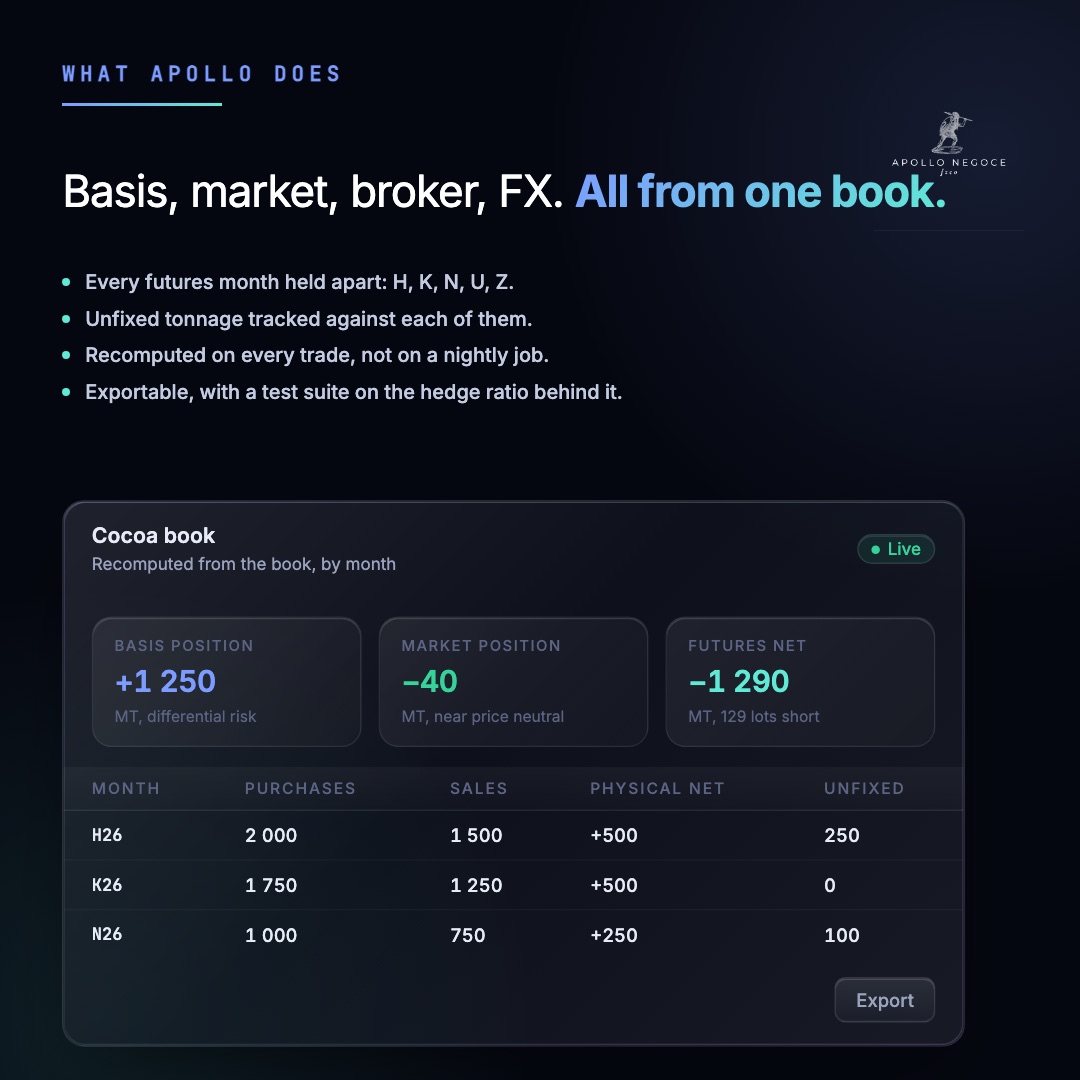
Read the example above: the physical book is long 1,250 tonnes, the futures are short 1,290, so the market position is 40 tonnes short. Three numbers, one book, no reconciliation between two files.
A hedge ratio per commodity, with tests behind it
Not every commodity is hedged one to one. Apollo applies the hedge ratio per commodity rather than a flat ratio across the book, and a dedicated test suite sits behind the calculation. When a number decides how many lots you buy or sell on the exchange, the arithmetic should be checked by something other than the person reading it.
The views can still be exported, for a risk report or a lender. The difference is that the export is taken from the book rather than rebuilt beside it.
Nobody rebuilds it in a spreadsheet on Monday morning. It was never out of date.
Live today
This module is in production: positions, broker positions, FX positions and the export views are part of the Apollo Negoce CTRM.
Frequently asked questions
How often is the position updated in Apollo Negoce?
On every trade. The position is computed from the contracts and futures in the book each time one is entered or changed, not by an overnight job.
What is the difference between basis position and market position?
The basis position is the physical book: what you bought against what you sold. The market position adds the futures that hedge it. A desk long 1,250 tonnes of physical and short 1,290 tonnes of futures is 40 tonnes short on the market.
Is the hedge ratio the same for every commodity?
No. Apollo Negoce applies the hedge ratio per commodity rather than one flat ratio for the whole book, and the calculation is covered by a dedicated test suite.
Can the position be exported?
Yes. The position views can be exported for a risk report or a lender, taken directly from the book.