EUDR is not a debate any more. It is a date, and that date has already moved more than once. It will not move forever.
Most of the conversation is about the due diligence statement. The hard part sits underneath it: proving, plot by plot, that the beans did not come from land cleared after 31 December 2020.
Every plot screened, the gaps first
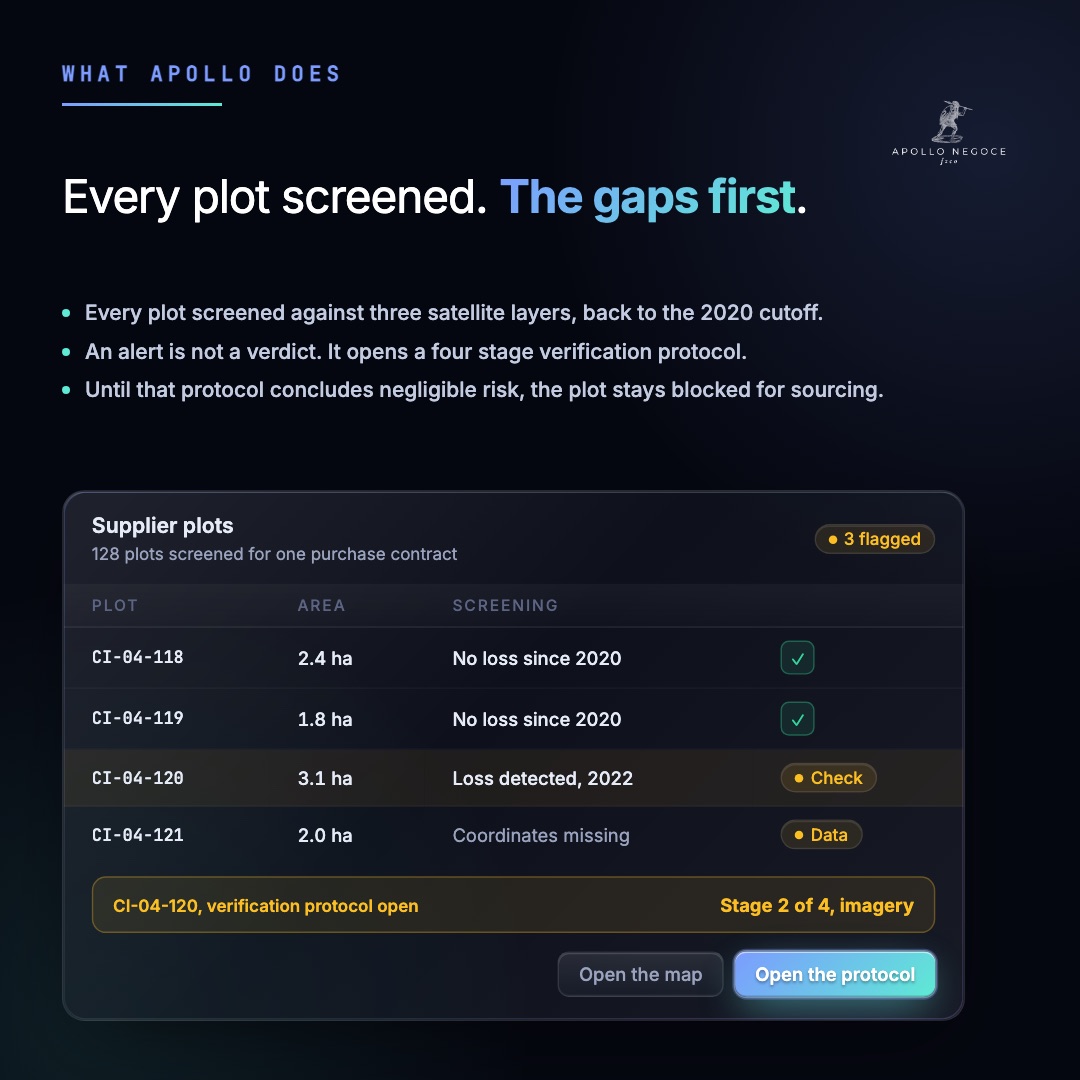
That module has been in Apollo since June 2026. Every plot behind a purchase contract is screened against three public satellite layers, Global Forest Watch, Whisp and the JRC Tropical Moist Forest map, back to the cutoff. The risk is aggregated, and each check is stored with its date.
The plots with no usable coordinates are flagged first, because they are the ones that take weeks to fix. A missing polygon is not a compliance problem you solve at shipment. It is a field visit you schedule months before.
An alert is not a verdict
A satellite layer raising an alert does not mean the plot was deforested. It opens a verification protocol in four stages:
- Farm metadata: was the plot already managed agriculture before the cutoff?
- Satellite imagery review: high resolution imagery before and after the cutoff, side by side, taken at its real capture date rather than the date of the map version.
- Field check: a visit to the plot to estimate the age of the trees.
- History and remediation, when deforestation still cannot be ruled out.
It closes on a named verdict: negligible risk, deforestation confirmed, or inconclusive. The verdict is signed, with the reasoning written down. Until it concludes negligible risk, that plot stays blocked for sourcing.
Deforestation free is a claim. The file is the proof.
What an auditor asks for
Imagery before and after the cutoff, at its real capture date. The age of the trees, seen in the field. A named assessor, and the reason they gave. Being ready is not a slide. It is a file that survives being read.
This article is about the evidence underneath the due diligence statement. Apollo Negoce does not file the statement in the EU information system for you.
Frequently asked questions
What is the EUDR deforestation cutoff date?
31 December 2020. Cocoa, coffee and the other commodities covered by the EU Deforestation Regulation must not come from land deforested after that date.
Which satellite data does Apollo Negoce use for EUDR?
Three public layers: Global Forest Watch, Whisp and the JRC Tropical Moist Forest map. Every plot behind a purchase contract is screened against them, and each check is stored with its date.
What happens when a plot raises a deforestation alert?
It opens a four stage verification protocol: farm metadata, a before and after imagery review at the real capture date, a field check of tree age, then history and remediation if needed. It ends on a signed, reasoned verdict, and the plot stays blocked for sourcing until the verdict is negligible risk.
Does Apollo Negoce submit the EUDR due diligence statement?
No. Apollo Negoce builds the plot level evidence the statement relies on. The statement itself is filed by the operator in the EU information system.